
Thursday, August 15, 2013


Wednesday, April 10, 2013
Tuesday, April 9, 2013

Friday, March 1, 2013

Saturday, February 2, 2013
Philanthropy, Not Fundraising: I Have a Dream
Philanthropy,
Not Fundraising: I Have a Dream
I have a dream…
I have a dream for 2013 – and beyond. I have a
dream that this is the year your organization will move beyond defining
yourself by what you’re not (nonprofit) and will begin to define yourself by
what you are (social benefit). I have a dream that this is the year your
people will move from an attitude of taking and hitting people up (aka
“fundraising”) to a mindset of giving and lifting people up (aka
“philanthropy”). I have a dream this is the year your staff and volunteers will
move from enacting transactions to enabling transformation.
I have a dream you will push yourself and your organization towards
transformative change. You will take the bull by the horns, adapt to the
digital revolution and open yourself to the possibilities that change brings.
You will give up on the static donor pyramid, ladder and funnel theory of engagement
and put your donor at the center of a new, active engagement model that
reflects the myriad ways people connect with organizations and causes today.
I have a dream you will learn who your best influencers are and you will
embrace them. You will recognize you are no longer your best messenger.
You will understand that many forces beyond you influence your donor’s decision
to invest with you, and you will expand your thinking and operations from a
one-dimensional to a multi-dimensional model. You will allow your
constituents to engage with you at multiple points of entry, and to move freely
between these points during the lifecycle of their engagement.
… the sun will rise…
I have a dream you will ask not what your donors can do for you,
but what you can do for your donors. You will recognize that they
don’t serve you; you serve them. You will embrace the true meaning of
philanthropy as love of humankind. You will remember that your donors are
humankind; you must love them if you want to be a part of philanthropy.
Otherwise, you’re just transacting business.
I have a dream you will reevaluate your raison d’etre. You will ask
yourself whether you’re in the business of selling, and you won’t answer
cavalierly. You will not pat yourself on the back for being different than your
for profit brethren. You will not tell yourself that nonprofits are about
mission and values and doing good deeds; whereas for profits are about greed
and sales. You will reevaluate why people compare ‘making the ask’ to
‘making the sale.’
I have a dream you will embrace your role as a salesperson, understanding
how fundamentally human this is. You will understand that selling (the very
definition of which is to exchange or deliver for money or its equivalent) is
something that we’re constantly doing. And you will have an “ah ha” moment that
this is also what fundraising is about — a value-for-value exchange. A
donor gives something of value (money or an in-kind good or service) and the
charity returns something of value to the donor. As Daniel Pink
writes in his new book To Sell Is Human “the ability to move
others to exchange what they have for what we have is crucial to our survival
and our happiness. It has helped our species evolve, lifted our living
standards, and enhanced our daily lives. The capacity to sell isn’t some
unnatural adaption to the merciless world of commerce. It is part of who
we are.”
… the clouds will part…
I have a dream you will come from a place of love, not need. When
interacting with your supporters you will do more than tell folks how much
money you require. You will consider how your supporters benefit and what’s in
it for them if they invest with you. You will help people to value your
accomplishments by assuring they understand your impact. You will
recognize that if you don’t demonstrate impact, then you can’t expect folks to
worry what might happen were you to be unable to grow or, even worse, cease to
exist.
I have a dream you will speak to peoples’ hearts; not just
their heads. You will become aware that if the bulk of your communication
with supporters is about numbers, finances and pie charts rather than stories
of real people being helped, it will become increasingly difficult to expect
anyone to care enough about your mission to invest in your success.
I have a dream your leaders will embrace a culture of
philanthropy that engulfs your entire organization. You will eliminate
silos and include everyone in the transformative power of your mission. You
will make sure that everyone associated with your organization is clear about
the values you enact and has stories they can tell about the ways you help to
repair our world. Philanthropy will become the glue that binds everyone
together – every department and every volunteer – working towards a common
goal.
… and it will be because of
the light you shine.
I have a dream you will engage in philanthropy; not
fundraising. You will embrace the fact that just as business has
changed fundamentally, so must fundraising change fundamentally. You will
accept that we’re all social businesses now; merely “transacting” no longer
cuts it. You will agree that for too long fundraising has been approached as
transactional – as being primarily about money – and that this approach results
in fundraising being seen at best as an onerous chore; a necessary evil.
You will see that philanthropy is fundamentally social; it’s about love — and
nothing could be more transformational.
Friday, December 28, 2012
Thursday, December 6, 2012
Happy Holidays!
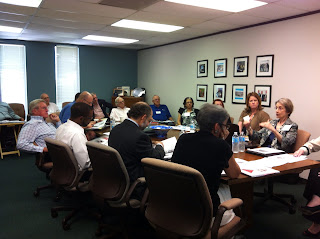
Thanks to an invitation proffered by Stoller Foundation, Executive Service Corps of Houston enjoyed learning about Capacity Building at the Houston Grantmakers Forum yesterday. Capacity building is a term frequently bandied about that the group agreed can mean anything from building the capacity of individual donors to group capacity building to community capacity building (i.e. how is the agency meeting community needs). Kudos for the subject matter!
It was helpful to hear how the nonprofit consulting industry is faring at year-end from veteran agency representatives, Cynthia Nunn, President and CEO, Center for Nonprofit Management, Dallas, Matt Kouri, President and Executive Director, Greenlights for Nonprofit Success, Austin, and Dr. Will Brown, Associate Professor and Director, Bush School of Government and Public Service, Texas A&M University, as well as hostess, Ronnie Hagerty, VP, Community Relations, United Way Houston. Times are difficult for nonprofits as has been reported throughout the year by Chronicle of Philanthropy and Nonprofit Times. Funding has remained steady or increased only slightly with little hope of change. The fiscal cliff debate will affect how donations will be deducted and the thought strikes fear in charities who are reliant on donations for survival.
 The sector is composed of optimists, and we frequently put the best face out to keep morale and income up. It is time for further assistance, however, according to these specialists and their peer, ESCH, from grant makers to help fund the education and training needed to make the nonprofits more self-sufficient and sustainable. Without vocal leadership from the funders, agencies will continue the same "bad" habits that keep them coming back for funding that might be avoided. Grantors need to follow-up on requests to assure board diversification, strategic planning and funding diversification. Budget reductions and creative collaborations are embraced by leading nonprofits to strengthen the organization's core and keep the body healthy. Grantmakers have an opportunity to offer guidance to and assistance through these various resources and locally, we would add University of Houston David Underwood Nonprofit Leadership Alliance and Rice University's Center for Philanthropy & Nonprofit Leadership, as well as Association for Fundraising Professionals, as educational resources.
This will take creativity, dedication and hard work from both sides to be ready to find ways to evaluate mission achievement and improve reporting so that funding justifications can be more easily made. We run the risk of losing some of the more needed charities, often too mission-focused, that do not take the time to plan and adequately review.
ESCH applauds and respects those funders who help keep nonprofit boards "feet to the fire" and focused on best management practices. We, like all of you, are striving to improve our bottom line of mission success. It is our challenge to help you become more successful and report on those of you who are as a result of working with our professionals. In doing so, we must become more relevant, flexible, responsive, consistent and educated about our own nonprofit community. If you have suggestions, please do not hesitate to share them. We are listening.
It was helpful to hear how the nonprofit consulting industry is faring at year-end from veteran agency representatives, Cynthia Nunn, President and CEO, Center for Nonprofit Management, Dallas, Matt Kouri, President and Executive Director, Greenlights for Nonprofit Success, Austin, and Dr. Will Brown, Associate Professor and Director, Bush School of Government and Public Service, Texas A&M University, as well as hostess, Ronnie Hagerty, VP, Community Relations, United Way Houston. Times are difficult for nonprofits as has been reported throughout the year by Chronicle of Philanthropy and Nonprofit Times. Funding has remained steady or increased only slightly with little hope of change. The fiscal cliff debate will affect how donations will be deducted and the thought strikes fear in charities who are reliant on donations for survival.

This will take creativity, dedication and hard work from both sides to be ready to find ways to evaluate mission achievement and improve reporting so that funding justifications can be more easily made. We run the risk of losing some of the more needed charities, often too mission-focused, that do not take the time to plan and adequately review.
ESCH applauds and respects those funders who help keep nonprofit boards "feet to the fire" and focused on best management practices. We, like all of you, are striving to improve our bottom line of mission success. It is our challenge to help you become more successful and report on those of you who are as a result of working with our professionals. In doing so, we must become more relevant, flexible, responsive, consistent and educated about our own nonprofit community. If you have suggestions, please do not hesitate to share them. We are listening.
Subscribe to:
Posts (Atom)